<Back to news
27 Apr 2026
Part 3 of School Readiness: Confidence Grows Without Competition
Written By Heidi Lopez-Gamez
Why children thrive when progress is personal, not comparative
As a Little Gym teacher, I get a front‑row seat to one of my favourite parts of childhood: watching confidence grow. And here’s what I’ve learned over the years, it doesn’t grow because a child is “the best” or because they outperformed someone else.
It grows in the quiet moments.
The wobbly moments.
The “I’m not sure I can do this” moments that turn into “I did it.”
That’s why our environment is intentionally non‑competitive. No rankings. No pressure to keep up. Just children discovering what they’re capable of, one small step at a time.
Progress is personal
Every child who walks into our gym brings their own strengths, fears, and spark. My job is to meet them where they are.
So we break every skill into small, achievable steps. Maybe today, a child jumps off a low block for the first time. Maybe they balance for one extra second. Maybe they simply try something they’ve been avoiding.
Those moments matter. They’re the building blocks of real confidence.
Research in early childhood development shows that children build stronger, more resilient self‑belief when they focus on their own effort and progress rather than comparison (NHS, Early Years Development). And I see that play out in class every single day.
Effort is celebrated just as much as success
One of my favourite things that one of our teachers says in class is, “Try your best, forget the rest.”
Because effort is where confidence begins.
When a child:
- Tries something new
- Practices a tricky skill
- Takes a safe risk
- Gets back up after a stumble
We celebrate it. Loudly. Joyfully. Genuinely.
The American Academy of Paediatrics highlights that this kind of encouragement helps children develop a growth mindset—the belief that they can improve with practice. And when children believe that, they become braver learners.
Supporting children through challenges
As teachers, we’re trained not just in physical skills but also in emotional coaching. That means:
- Offering a steady hand when something feels scary
- Breaking challenges into manageable steps
- Modelling calm problem‑solving
- Cheering for persistence, not perfection
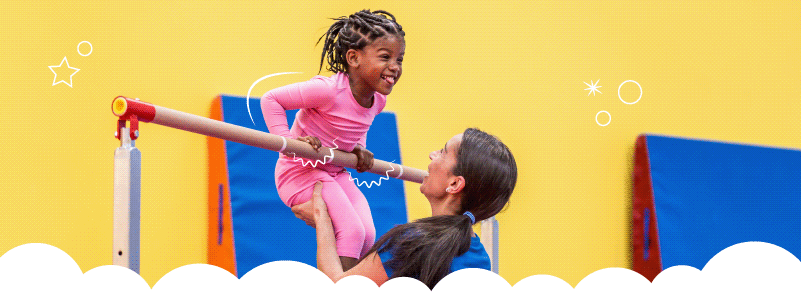
Sometimes a child will look at me with wide eyes and say, “I can’t.”
And I get to say, “Let’s try it together.”
When they finally manage it, whether it’s a forward roll, a jump, or simply stepping onto a new piece of equipment, the pride on their face says everything.
They’re not just learning a skill.
They’re learning something far more powerful:
“I can do hard things.”
Why this matters for school, and life
Children who believe in their ability to try, persist, and overcome challenges carry that confidence everywhere they go. In school, they’re more likely to:
- Join in
- Ask questions
- Keep going when something feels tricky
- Approach new experiences with curiosity
Confidence built from personal progress—not comparison—creates learners who are resilient, brave, and ready for whatever comes next.
And that belief doesn’t stay in the gym.
It follows them into classrooms, friendships, and life.
A simple takeaway for parents
If you want to nurture confidence in your child, focus less on being “the best” and more on helping them feel:
- Proud of their effort
- Supported through challenges
- Safe to try new things
- Encouraged to keep going
Confidence grows when children feel capable, not when they feel compared.
At The Little Gym, we see that transformation every day. And it’s one of the greatest joys of teaching here.
Coming next
In Part 4, we’ll explore howsocial‑emotional skills take shape through play, and why these early relationship skills are essential for a smooth transition into school.
If you’d like to see how confidence grows in a non‑competitive environment, we’d love to welcome you to a class and show you what’s possible.
References
American Academy of Paediatrics. (2018). The Importance of Play in Promoting Healthy Child Development and Maintaining Strong Parent-Child Bonds.
NHS. (n.d.). Early Years Development: Social and Emotional Development.